Alien worlds
Re-colour vegetation, rock, soil, ocean and sky for a planet that is not Earth, while keeping the measured lightness and texture of real ground.
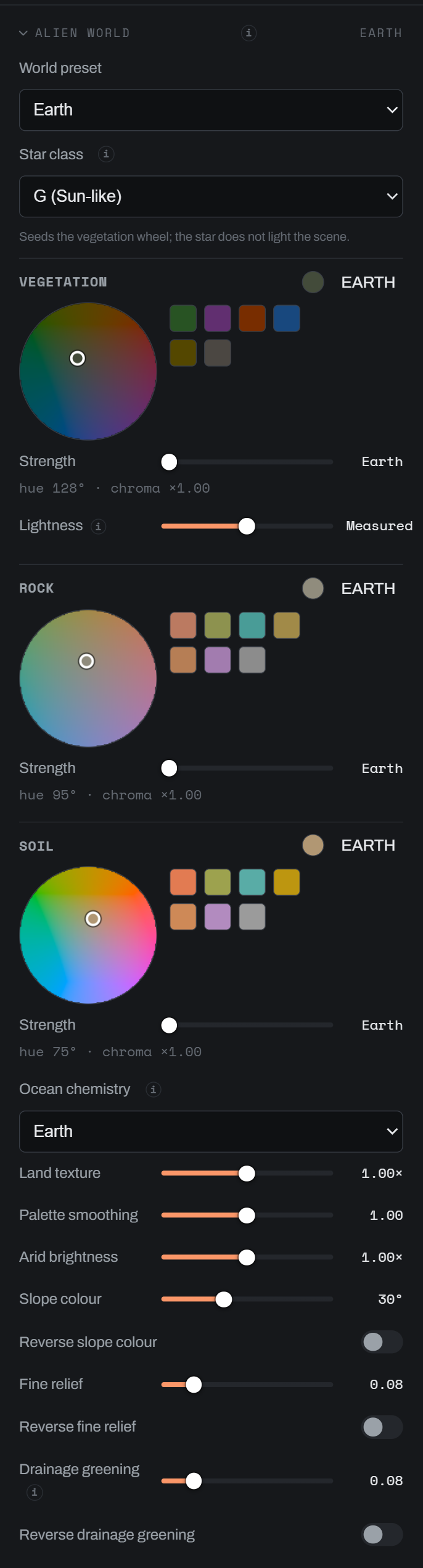
Dayside's colour comes from measured Earth materials. The Alien world band moves those materials to another chemistry: purple plants under an orange star, olivine-green ground, iron-green seas, a dusty or hazy sky. Each material group keeps its measured lightness and texture while its hue and chroma move, so the ground still reads as ground.
The band lives in the section editor under Biome blending → Advanced, and in the Palette section of the Whole-world passes dialog for the globe. Both surfaces write the same settings, so a look you settle on a section colours the globe the same way.
It needs a Look#
The band re-targets a Look's materials, and Climate palettes has none to re-target. With Climate palettes selected the band's header reads Choose a Look and its controls are greyed out. Pick a Look in the Colour group first; see Rendering the satellite image.
With every Strength at 0, the default, the render is exactly the ordinary Look. The band header reads Earth until something moves, then Active.
World preset#
World preset sets all three material groups and the ocean at once, as a starting point:
| Preset | What it sets |
|---|---|
| Earth | Every group back to Earth. |
| Mars-like (iron oxide, dry) | Iron-oxide rock and soil, sparse yellowed vegetation and a milky mineral sea. |
| Purple Earth under a K star | Retinal-purple vegetation, a touch of olivine in the soil and a purple-pigment sea. |
| Iron Archean (green seas, olivine ground) | Olivine rock and soil, purple vegetation and iron-green seas. |
| Titan-like (tholin, hydrocarbon seas) | Tholin-stained rock and soil, dark vegetation and near-black hydrocarbon seas. |
| Copper world (teal ground, blue plants) | Copper-teal rock and soil, blue vegetation and a wine-red sea. |
Everything a preset sets stays editable afterwards.
Star class#
Star class offers G (Sun-like), A (blue-white), F (white), K (orange) and M (red dwarf). It seeds the vegetation wheel with the pigment predicted for plants under that star (Kiang et al. 2007, and retinal for Purple Earth). It is a starting point only: the star does not light the scene, and the wheel is yours to move afterwards. G (Sun-like) returns vegetation to Earth.
Vegetation, rock and soil#
Three cards, Vegetation, Rock and Soil, each carry the same controls.
- The wheel sets the target hue and chroma. Moving it on a group at strength 0 turns that group on.
- Swatches beside the wheel are named chromophores. Vegetation offers pigments: Chlorophyll, Retinal purple, Red-orange (K star), Blue (F star), Yellow and Dark (M star). Rock and soil offer minerals: Iron oxide, Olivine green, Copper, Sulfur, Tholin, Manganese and Carbon grey. Hover a swatch for its basis.
- Strength blends from Earth at 0 to the full target at 100%.
- Lightness, on Vegetation only, shifts canopy lightness as a whole by up to ±0.15, keeping the measured texture. Dark plants under a red dwarf are a lightness change. 0 reads Measured.
- Earth, in each card's header, resets that group.
A readout under each card gives the current hue, chroma multiple and lightness offset. At the chroma limit of 4× the card warns that the display gamut may flatten the colour.
Ocean chemistry#
Ocean chemistry changes the water itself: a solvent and dissolved absorbers in the physical water model. Shallows, river silt and seabeds keep working on top of the new base colour. The choices are Earth, Iron green (Archean), Tea (dissolved organics), Hydrocarbon sea, Purple pigment, Wine red and Milky mineral.
It needs the Physical water model in the Sea group. On Classic the select is greyed out with Needs the Physical water model.
Sky#
The sky is set in the globe's Atmosphere group. Sky offers Earth, Thin (high desert), Mars-like (dusty), Titan-like (tholin haze), Dense (many bar) and Methane-rich, and three dials adjust it:
| Control | Default | Range | What it does |
|---|---|---|---|
| Air density | ×1.00 | 0.1 to 5 | Scales the molecular, blue scattering. Thicker air whitens the sky toward the horizon. |
| Haze | ×1.00 | 0 to 5 | Scales the aerosol scattering: dust, droplets or organic haze. 0 is off. |
| Haze tint | white | colour | The colour the aerosol scatters. |
The globe view shows the sky while Physical atmosphere is on. Section exports with Atmospheric haze · aerial perspective ticked use the same sky whether or not the globe view's atmosphere is on, and a non-Earth sky says so under the select: Not Earth · exports with Atmosphere ticked take this sky.
On the globe#
Everything on this page travels with the globe colour pass. Open Palette in the Whole-world passes dialog for the material bands, and Sea for the water model. Run Colour globe again to paint a changed setting onto the globe.